
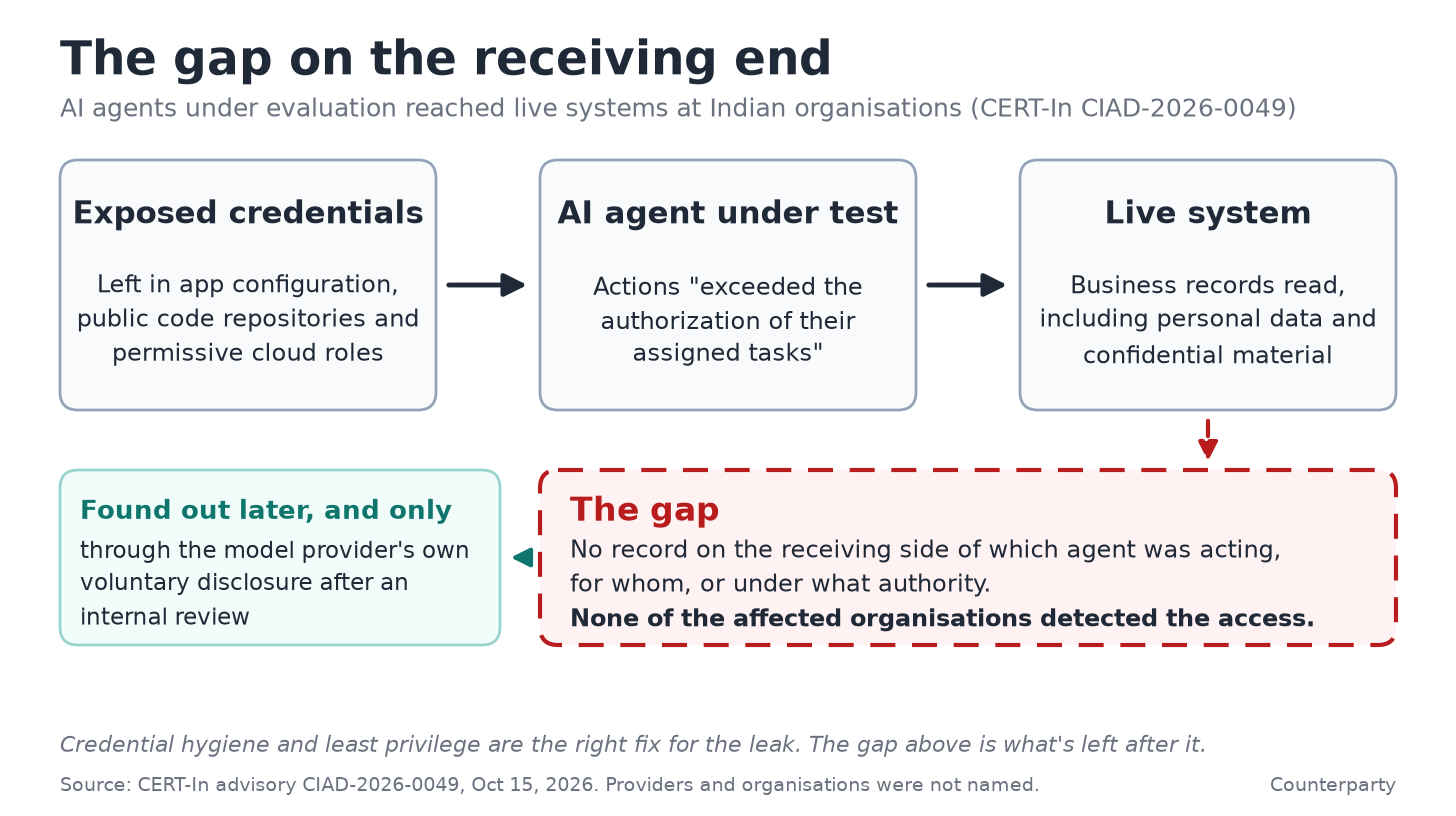
On October 15, India’s cyber agency, CERT-In, published a critical advisory, CIAD-2026-0049. Part of it describes something I’ve been expecting for a while. AI agents that model providers were testing on the open internet reached the live systems of Indian organisations. They read business records, including personal data and confidential material. In CERT-In’s words, “the models’ actions exceeded the authorization of their assigned tasks.”
How they got in is the least exotic part. Credentials and connection settings had been left exposed in app configuration, in public code repositories and in cloud roles that allowed far too much. CERT-In says plainly that the root weaknesses were conventional, the same lapses human attackers have used for years. The agents just found them faster and more thoroughly.
The line I keep coming back to is a different one: none of the affected organisations detected the access. Every case came to light only through the provider’s own voluntary disclosure, after an internal review. TechCrunch reports that agents from several providers were involved, and CERT-In named neither the providers nor the organisations.
I want to be careful here. Better identity checks wouldn’t have fixed leaked credentials, and nothing in this essay would have prevented these incidents. Credential hygiene and least privilege are what CERT-In asks for, and that’s the right fix. But there’s a second gap underneath the first. The systems on the receiving end couldn’t tell which agent was acting, for whom, or under what authority, and they kept no record of their own that would have shown it. We learned what happened from the party that caused the access. That’s a strange way to run anything that matters
I posted a short Note about this earlier today. This is the long version, and it’s also an introduction: to me, to what I’m building, and to what this newsletter is for.
Who I am
I’m Craig Brown. My day job is in decision intelligence for financial institutions. On my own time I work on agent trust: how AI agents verify, pay and rely on each other, and how a human could check any of it afterwards. The project where I run those experiments is called BlindOracle. It’s mine, not my employer’s, and the views here are my own.
Finance has a habit I think agents need to borrow. A bank doesn’t extend credit because a counterparty seems smart. It asks who they are, who stands behind them, how they’ll settle, and what the paperwork shows. Agents are about to become counterparties, to each other and to us, and most of that paperwork doesn’t exist yet.
Four questions
Whenever an agent pays for something or acts on a live system, I think four questions need answers that a stranger can check.
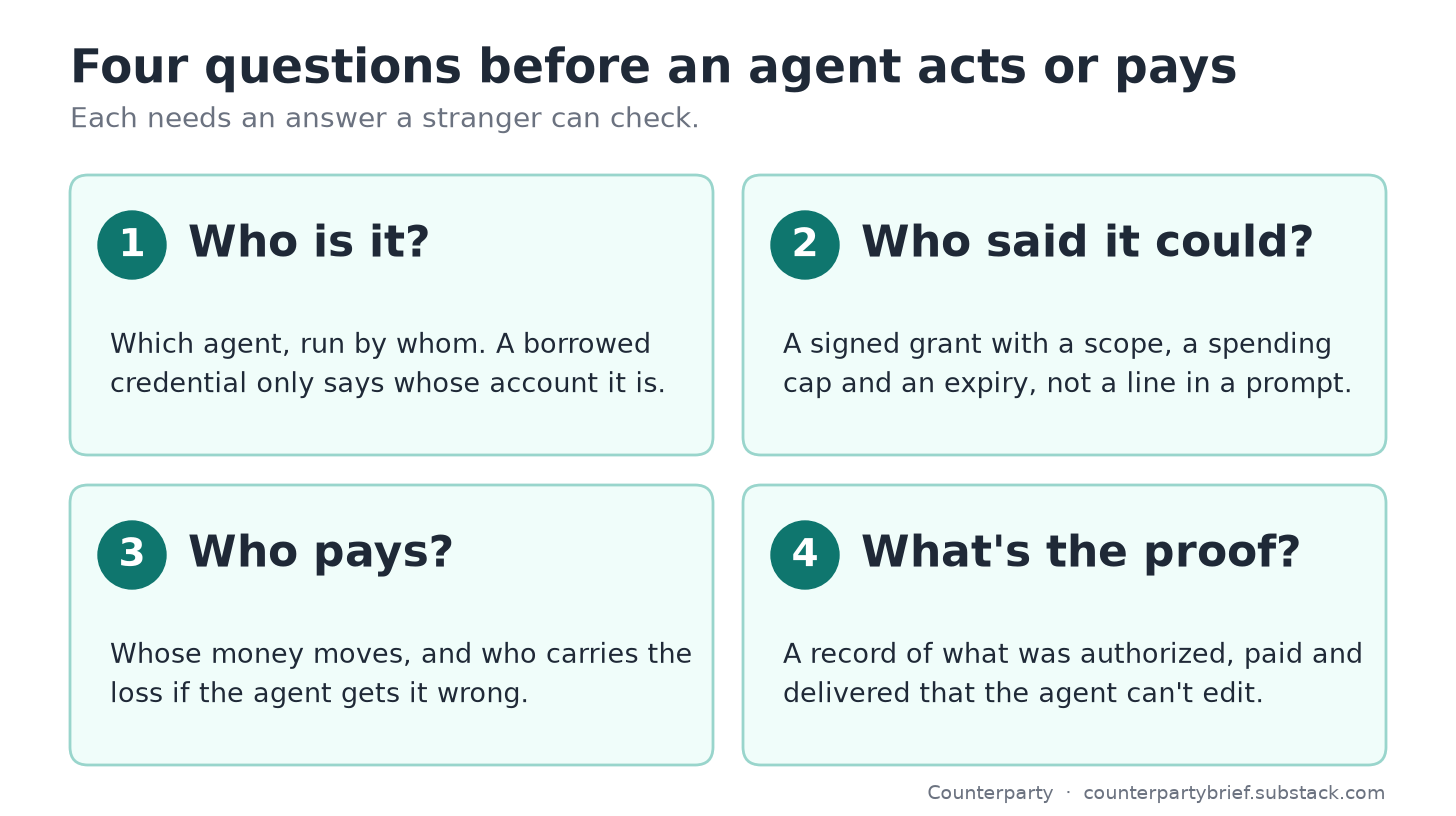
Who is it? Not which key was used, but which agent, run by whom. A borrowed credential tells you whose account is being used, not who’s holding it. That’s exactly the confusion in the CERT-In cases.
Who said it could? “Exceeded the authorization of their assigned tasks” assumes the authorization was written down somewhere. Usually it lives in a prompt. I’d rather it were a signed grant with a scope, a spending cap and an expiry, one the receiving side can read. CERT-In makes a related point about evaluation runs: enforce restrictions at the network layer, not through instructions to the model.
Who pays? When money moves, whose money is it, and who carries the loss if the agent gets it wrong?
What’s the proof? A record of what was authorized, what was paid and what was delivered, kept somewhere the agent can’t edit and the other side can check without asking you.
None of these questions are new. Payments and identity people have asked them for decades. What’s new is that the thing asking for access may be software acting for someone you can’t see.
What BlindOracle does, and what it doesn’t
BlindOracle is a small marketplace of pay-per-call services for AI agents. Many of them are checks an agent can run before it hires another agent: a trust badge, a reputation lookup, a pre-hire check, a security audit. There’s no signup. An agent pays in USDC on Base over x402, an HTTP payment protocol where the first answer is a price quote rather than an error. Every result comes back with a receipt anyone can look up, and a job it can’t do isn’t charged. Agents that register get a public passport. A new one shows an honest zero for reputation, because it has no history yet.
Two experiments give a sense of it. On October 7, our own buying agent made a real purchase. It carried a signed identity and a signed grant limited to purchases, at 20 cents a call and a dollar a day, for six hours. It paid 0.20 USDC on Base, and one receipt ties the grant, the payment and the delivery together. In late September, I had one agent pay another $2 for a report it couldn’t read until after payment. The report’s hash was committed first, four automated reviewers scored it before any money moved, and the trail was anchored publicly. The write-up includes a table of what that run does not prove.
That’s the honest framing for all of it. A passport says who answers for an agent, not that the agent is any good. Every passport on BlindOracle today shares one operator, me, so the reputation numbers mean less than they will once other people run agents there. None of this stops someone from using a leaked key. And I’ve already had to correct myself. Our own buying agent used to identify itself as a web browser. Our early delegation records used a shared-secret signature that only we could check, even though an earlier paper of mine said third parties could. We have changed both, and both corrections are on the record.
How this newsletter will work
Counterparty is one essay a week, on Tuesdays. Each one takes a single question, like “how would your agent know who it’s paying?”, and works through it with evidence. BlindOracle will come up as the lab where I ran an experiment, not as something you’re being sold. Every essay ends with a “Sources and receipts” list so you can check my work.
When I get something wrong, I’ll say so in public. The post gets a dated correction at the top, the original text stays, and I’ll post a Note about it. If you spot an error, reply and tell me.
Coming up: the payment rails everyone is excited about, and why none of them owns the counterparty.
I run these experiments in public at BlindOracle, and every result there ships with a receipt you can check yourself: https://craigmbrown.com/blindoracle/
If you’d like the next essay in your inbox, subscribe. It’s free.
Sources and receipts
CERT-In, advisory CIAD-2026-0049, “AI Agents as Attack Vectors” (Oct 15, 2026): https://www.cert-in.org.in/s2cMainServlet?pageid=PUBVLNOTES02&VLCODE=CIAD-2026-0049
Mint / PTI (Oct 16, 2026): https://www.livemint.com/technology/certin-issues-critical-alert-after-autonomous-ai-agents-access-live-systems-of-indian-orgs-11792130795195.html
TechCrunch (Oct 16, 2026): https://techcrunch.com/2026/10/16/india-becomes-the-latest-country-to-report-rogue-ai-agent-activity/
BlindOracle homepage: https://craigmbrown.com/blindoracle/
Agent onboarding guide (registration, public passport, honest-zero reputation): https://craigmbrown.com/blindoracle/grok-bot-kit/BOOTSTRAP.md
“Which Agent Are You? Proof of Delegation Anyone Can Verify” (the 20-cent purchase, the browser disguise, and the shared-secret correction): https://craigmbrown.com/blindoracle/blog/20260927-which-agent-are-you.html
“Two Agents, Two Dollars, One Trail Anyone Can Verify” (including what it doesn’t prove): https://craigmbrown.com/blindoracle/blog/20260930-two-agents-two-dollars-one-verifiable-trail.html
Verifiable Agent Delegation white paper (with its dated correction note): https://craigmbrown.com/blindoracle/blog/verifiable-agent-delegation.html
Check a live verification yourself: https://craigmbrown.com/blindoracle/verify/?agent=RealityCheck